Constrain nodes displacements in 3D
Figure 10 shows a mesh with nelx = 2, nely = 2, nelz = 1, and how the nodes are numbered.
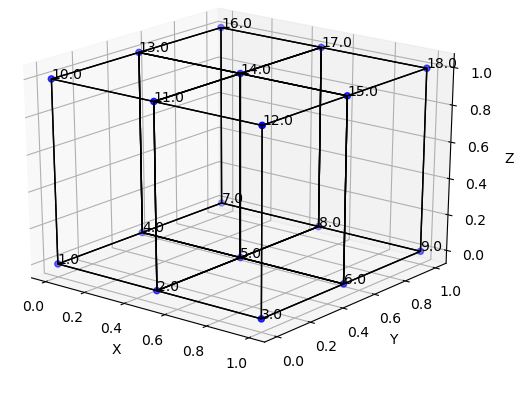
Figure 10: 3D mesh with numbered nodes.
It’s passed a list of dictionaries. There are two options for constrain nodes displacements:
Constrain nodes displacements by column
Constrain nodes displacements by coordinate
Hint
It’s possible combine and use both options.
Constrain nodes displacements by coordinate
The dictionary has the following keys:
“x_coord”: coordinate in X-axis.
“y_coord”: coordinate in Y-axis.
“z_coord”: coordinate in Z-axis.
- “constrain_disp_x”: indicates if the node displacement is contraint in X-direction.
If 1 constrain the node displacement in the X-direction.
If 0 don’t constrain the node displacement in the X-direction.
- “constrain_disp_y”: indicates if the node displacement is contraint in Y-direction.
If 1 constrain the node displacement in the Y-direction.
If 0 don’t constrain the node displacement in the Y-direction.
- “constrain_disp_z”: indicates if the node displacement is contraint in Z-direction.
If 1 constrain the node displacement in the Z-direction.
If 0 don’t constrain the node displacement in the Z-direction.
In the example is constrained the node displacement at coordinateS (1, 0.5, 0.3) and (1, 0.5, 0).
restri_matrix = [{"x_coord":1, "y_coord":0.5, "z_coord":0.3, "constrain_disp_x":1, "constrain_disp_y":1, "constrain_disp_z":1}, \
                 {"x_coord":1, "y_coord":0.5, "z_coord":0, "constrain_disp_x":1, "constrain_disp_y":1, "constrain_disp_z":1}]
The resulting mesh is shown in figure 11.
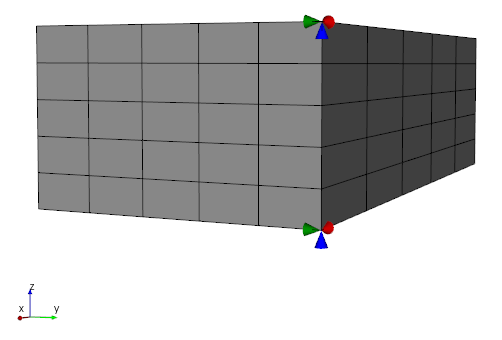
Figure 11: Mesh with nodes at coordinates (1, 0.5, 0.3) and (1, 0.5, 0).
Constrain nodes displacements by column
The dictionary has the following keys:
“coord”: coordinate.
“axis”: Direction that the node displacement is constraint. It can be: 1 (X-Axis), 2 (Y-Axis) or 3 (Z-Axis).
“eps”: Margin of error.
- “constrain_disp_x”: indicates if the node displacement is contraint in X-direction.
If 1 constrain the node displacement in the X-direction.
If 0 don’t constrain the node displacement in the X-direction.
- “constrain_disp_y”: indicates if the node displacement is contraint in Y-direction.
If 1 constrain the node displacement in the Y-direction.
If 0 don’t constrain the node displacement in the Y-direction.
- “constrain_disp_z”: indicates if the node displacement is contraint in Z-direction.
If 1 constrain the node displacement in the Z-direction.
If 0 don’t constrain the node displacement in the Z-direction.
In the example is constrained the X displacement of the nodes in the plane Z = 0.3.
restri_matrix = [{"coord":0.3, "axis":3, "eps":0.001, "constrain_disp_x":1, "constrain_disp_y":0, "constrain_disp_z":0}]
The resulting mesh is shown in figure 12.
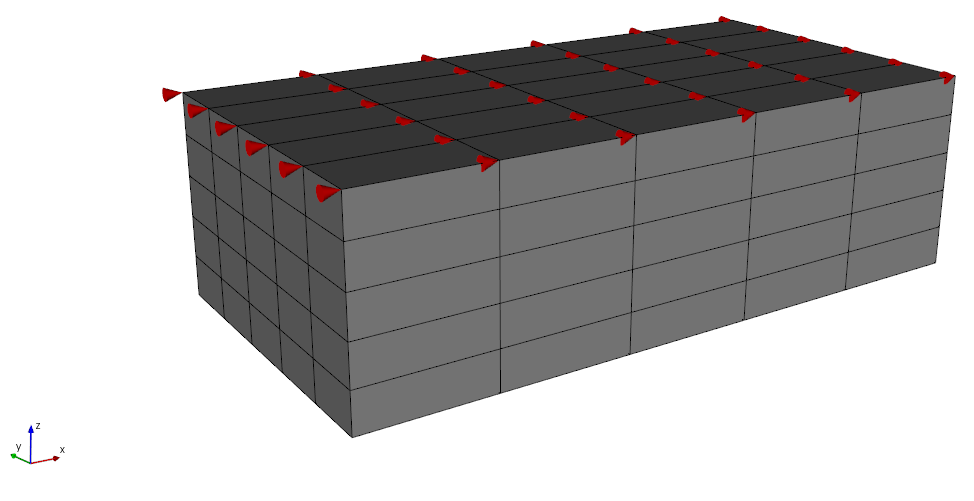
Figure 12: Nodes in the plane Z = 0.3.